Published: May 18, 2026, 03:58 PM
When France declared that Algerian intellectuals had no place in the independence struggle, an entire generation of students, doctors, engineers, nurses, teachers proved it wrong by giving up everything to join the maquis.
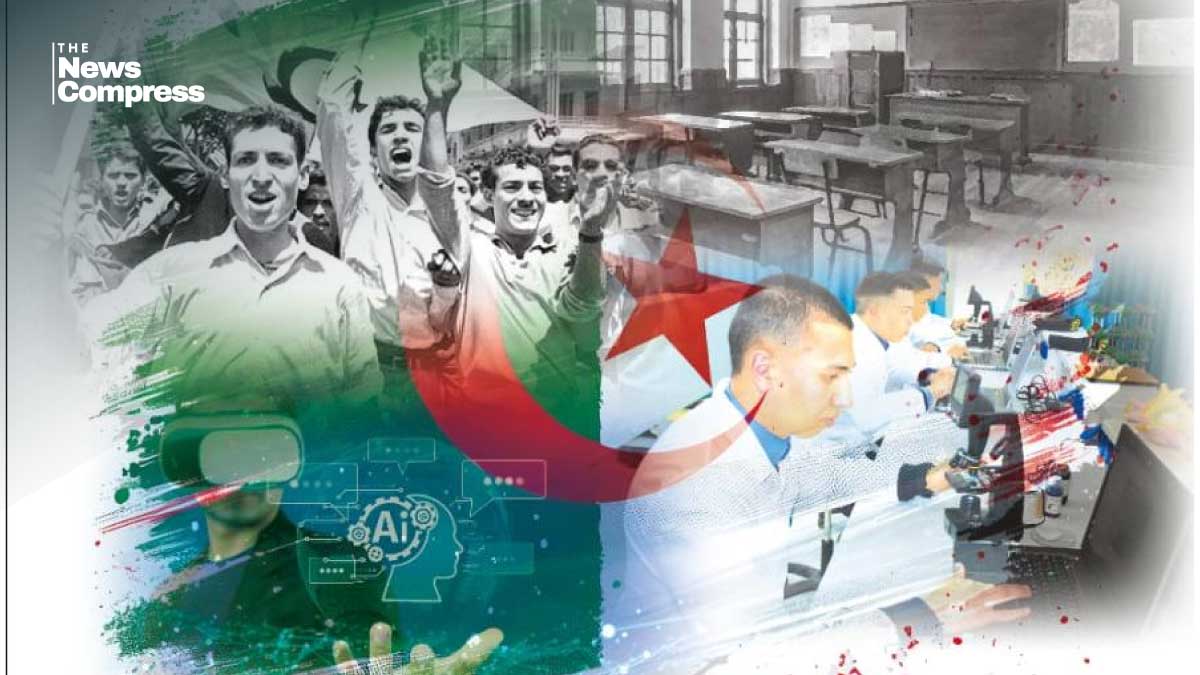
On the morning of 19 May 1956, something remarkable happened across Algeria and in Algerian student communities throughout France. Hundreds of young men and women, future doctors who had not yet treated a patient, engineers who had not yet built a structure, nurses, teachers and students from every discipline rose from their desks, put down their pens, and chose a different path entirely. They left their universities, their examinations and their academic futures behind to answer a single call: the call of the National Liberation Front to join the revolution and fight for Algeria’s independence.
To understand the full weight of this act, one must understand the climate in which it was made. Since the launch of the revolution on 1 November 1954, the Algerian independence movement had been gaining strength in the mountains and cities of Algeria. But France, for its part, maintained a calculated position: that the conflict was an internal security matter, and that Algeria’s educated class, its students, its professionals, its intellectuals were separate from the struggle. In French colonial thinking, these young Algerians who had passed through French schools and universities were the product of French civilization. They were expected to remain loyal, or at the very least, neutral.
This position was not only a political calculation, it was a deliberate provocation. France had spent more than a century restricting Algerian access to education. At the University of Algiers on the eve of the 1956 strike, Algerian Muslim students were outnumbered by European classmates by roughly nine to one. Those who had managed to reach higher education had done so against every obstacle colonial policy could place in their way. And yet France expected them to stand aside while their people were subjected to mass repression.
By early 1956, that repression had reached new heights. French Prime Minister Guy Mollet deployed more than 400,000 soldiers to crush the independence movement, authorizing tactics that included mass displacement of civilian populations, the destruction of homes and villages, and the systematic use of torture during interrogations. Algerian intellectuals and student leaders were no longer just watched and monitored, they were arrested, imprisoned and killed. In January 1956, colonial forces killed student militant Belkacem Zeddour and Dr. Benaouda Benzerdjeb, a physician linked to the student movement. These acts of violence against educated Algerians made one thing absolutely clear: France’s claim that intellectuals were not part of the revolution was not a statement of fact. It was a demand for submission.
France moved aggressively to suppress any student mobilisation. It cut off scholarships to Algerian students it deemed politically active, placed student leaders under surveillance, and arrested those who organised openly. For Algeria’s young educated class, the message was clear: France would not allow its intellectuals to stand with their people. But repression only hardened resolve. The Revolution, meanwhile, had an urgent and growing need, not only for armed fighters in the maquis, but for doctors to treat the wounded, engineers to manage logistics, nurses to staff field hospitals, and educated volunteers of every kind to strengthen its ranks against the French occupation army. The call to Algeria’s students was therefore both a patriotic appeal and a strategic necessity.
The General Union of Algerian Muslim Students, UGEMA had been founded on 8 July 1955 in Paris, bringing together Algerian students from across France and Algeria under a single national organization. By March 1956, at its second congress in Paris, UGEMA had taken an unequivocal stance: Algerian independence was the primary objective, and the union placed itself fully at the service of the National Liberation Front. Its founders, among them Ahmed Taleb Ibrahimi, Mohamed Seddik Benyahia, Abdelhamid Mehri and Aïssa Messaoudi understood that the independence of Algeria could not be won without the full participation of every Algerian, educated or otherwise. When Mouloud Belaouane, elected UGEMA president in April 1956, issued the historic call, it was the outcome of two urgent general meetings held on 17 and 18 May at the Dr. Saâdane Club in Algiers, two days of deliberation that ended with one irreversible decision: an indefinite strike from all classes and examinations, and collective engagement in the ranks of the FLN.
“We must desert the university benches for the maquis. The hour is grave. There is no longer any place for neutrality.”
— UGEMA Strike Manifesto, 19 May 1956.
The response to UGEMA’s call was immediate and overwhelming. The strike was general and unlimited covering all classes and all examinations, and it extended to every Algerian student, both inside Algeria and in French universities abroad. What distinguished it from all earlier acts of student protest was the breadth and the unity of those who answered. This was not a movement of one faculty or one city. Students of medicine, pharmacy, engineering, law, science and the humanities all walked out together. Men and women alike answered the call. Whether they were on the verge of their first examinations or days away from a final degree, they set their studies aside without hesitation.
Many joined the maquis directly, taking up arms alongside the fighters of the National Liberation Army. Others took on clandestine roles in Algerian cities, gathering intelligence, carrying messages and supporting the urban resistance networks. Those who were expelled to France or forced into exile in Switzerland and other European countries continued their studies where they could, but also continued their service to the cause, carrying Algeria’s case to international student assemblies and winning recognition for the justice of the Algerian struggle from student organizations across both sides of the Cold War divide.
The contribution of the student strikers to the military capacity of the National Liberation Army was profound and lasting. The ALN had urgent need not only of fighters, but of doctors, nurses and medics capable of treating the wounded under battlefield conditions. Medical students who had not yet received their degrees set up field medical services in the mountains and forests of the maquis. Pharmacy students managed the supply and distribution of medicines under conditions of extreme scarcity. Engineering students applied their technical knowledge to logistics, communications and the construction of resistance infrastructure. The revolution, which France had sought to portray as a rural and uneducated uprising, was given by the student strike a new and undeniable character: it was also the revolt of Algeria’s most educated generation. In answering the call of 19 May, Algeria’s students did not merely join a war, they transformed it.
France’s response to the strike was swift and punishing. Scholarships were revoked. UGEMA itself was formally dissolved by the French government on 28 January 1958, on the grounds that it had placed itself at the service of the FLN, a charge its members considered a badge of honour. The organization reconstituted itself in exile in Tunis, where it continued to serve the revolution until independence was won.
Three months after the strike of 19 May, the landmark Soummam Congress of August 1956 established the full political and military structure of the FLN. The student movement’s mass adherence had already demonstrated, before that congress was held, that the Algerian revolution was not a minority uprising but a national one, endorsed and joined by every class and every generation. The students of UGEMA did not merely support the revolution. They helped define what it was. And when independence finally came on 5 July 1962, it was they who returned from the maquis, from exile, and from prison cells to build the nation their sacrifice had made possible.
That independence was a victory won at great cost, by a people who had given everything, including an entire generation of their most promising young minds. The Algeria that emerged from that struggle was a young nation in every sense, and it has remained one. Today, more than 70 percent of Algeria’s population is under the age of thirty. This is not simply a demographic statistic. It is the living continuation of the spirit of 19 May 1956, a youthful, dynamic and engaged population that continues, generation after generation, to serve and to build the country that the students of 1956 made possible.
Independent Algeria understood from its very first days that this youth had to be educated. In 1962, France left behind a country where illiteracy exceeded 85 percent of the population and fewer than 3,000 students were enrolled in higher education across the entire territory. The new Algerian state made education its most urgent national priority. Universities and centres of knowledge were established not only in the major cities of Algiers, Oran and Constantine, but progressively in every region of the country, in all fifty-eight wilayas. By 2025, Algeria had grown from fewer than ten higher education institutions at independence to 115, enrolling nearly two million full-time students. Women, almost entirely excluded from higher education under colonial rule, now make up more than sixty percent of university enrolment among the highest rates of female participation in higher education in the world.
This expansion of knowledge and opportunity is the most enduring legacy of 19 May 1956. The students who walked out of their classrooms to fight for an independent Algeria walked back into those classrooms after 1962 as ministers, professors, doctors, engineers and diplomats to build the very institutions that today serve millions of young Algerians. The Algeria of 2026, with its universities spread across every region, its growing scientific research base, and its young population driving its socioeconomic and cultural development, is the answer to the question those students asked themselves on the morning of 19 May 1956: what is education for, if not for the freedom and progress of one’s people?
Seventy years on, commemorating 19 May is above all an occasion to honour the bond between two generations of Algerian students: the generation of struggle, which gave up everything so that Algeria could be free, and the generation of construction, which inherited that freedom and carries the responsibility of building on it every day.