
Published: March 14, 2026, 01:15 PM
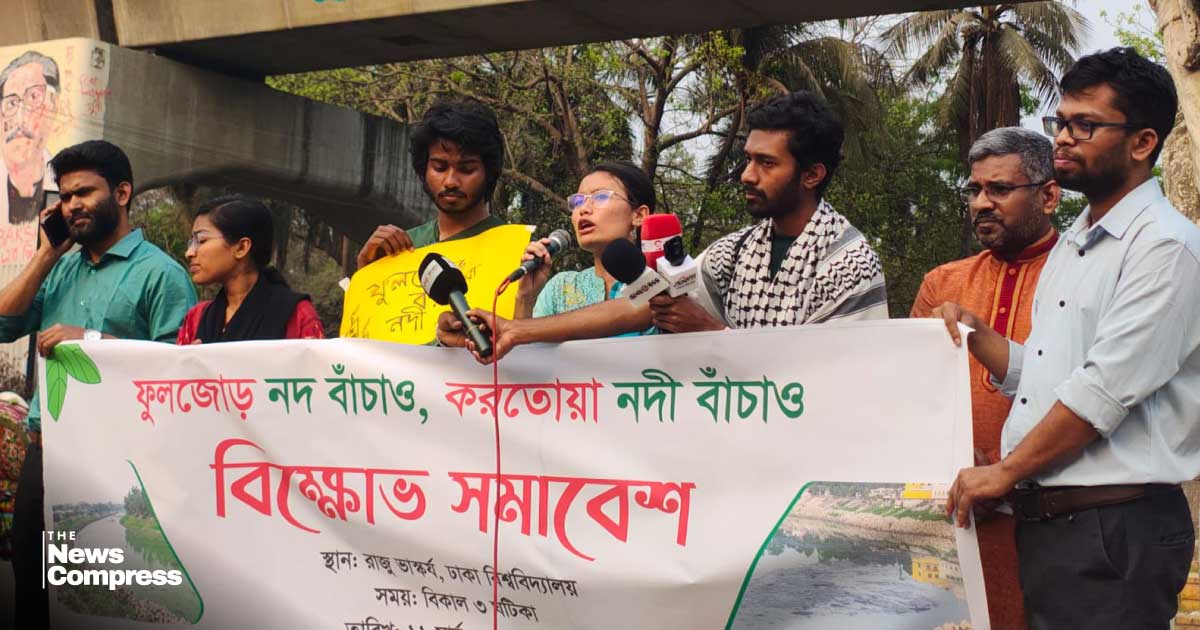
Students, human rights activists, and young environmentalists gathered at the iconic Raju Sculpture of Dhaka University to protest industrial pollution in the Phuljore and Karatoa Rivers. The protesters demanded urgent action, including investigations into industrial waste pollution, strict enforcement of environmental laws, and measures against the responsible individuals and companies. They also called for an end to the harassment of environmental activists.
The assembly was moderated by Sohanur Rahman, executive coordinator of environmental organization YouthNet Global. Speakers included Dr. Ahmad Kamruzzaman Majumder, Professor of the Department of Environmental Science at Stamford University Bangladesh, Dhaka University Central Students’ Union (DUCSU) executive members Hema Chakma, Writer Mahbub Siddique, Activists Jakia Shishir, Faysal Biawas and Mst Ruku Khatun, General Secretary of Kabi Sufia Kamal Hall DUCSU.
Speakers highlighted that industrial waste is severely polluting the rivers, threatening agriculture, fisheries, biodiversity, and the livelihoods of local communities. Many families are already facing crises due to land grabbing and environmental degradation.
The approximately 55-kilometer-long Phuljore River supports the livelihoods of hundreds of thousands of people in Sirajganj and Bogra districts. Protesters alleged that chemical waste from several industries, including SR Chemicals, owned by the family of Golam Mohammad Siraj, Member of Parliament for Bogra-5, and Majumdar Products, is causing severe river contamination.
Activists emphasised that unless effective measures are taken to protect the rivers, the movement will continue to grow. They also pledged to strengthen youth participation for the sake of rivers, the environment, and future generations.
Faysal Biswas, a young environmental activist from Sirajganj, said, “Rivers are our lifeblood. If pollution continues, we risk environmental disaster and losing our livelihoods. I have been conducting a sit-in here for six days. We will continue our movement until the river is safe.”
Sohanur Rahman added, “Rivers are living entities. Industrial pollution is destroying them and damaging the entire ecosystem. Bangladesh’s rivers are the foundation of our livelihoods and environment. A polluted river affects not just the local area but the whole ecosystem.”
In a landmark 2019 ruling, Bangladesh’s High Court declared all rivers “living entities” and appointed the National River Protection Commission as their guardian. Activists say that without proper implementation of this ruling, effective river protection remains impossible.
According to local residents and environmental organizations, chemical waste on February 21–22 poisoned the Phuljore River, killing fish, snakes, frogs, crabs, and snails. Protests followed in Dhangara, Sirajganj, on February 24 and at the Chandaikona bus stand on February 25, including human chains and submissions of memorandums to local authorities.
Later, protesters peacefully demonstrated in front of SR Chemicals and Majumdar Products in Sherpur Upazila, Bogra. Some participants were allegedly targeted with extortion cases. On March 1, police arrested Touhidur Rahman alias Babu (45) and college lecturer Ali Reza Biswas, who were later granted bail in Bogra court.
The movement continued with a demonstration at the National Press Club on March 5. On March 6, leaders, women, and children of the indigenous Mahato community of Bogra joined environmental activists in Dhaka for another protest at the Raju Sculpture. Meanwhile, Faysal Biswas continues a six-day sit-in at Dhaka University’s TSC.