Published: June 15, 2026, 06:20 PM
Frontline climate-affected communities and experts urged stronger inclusion of local voices, increased adaptation support and fair climate finance at a policy dialogue in Dhaka, highlighting lived experiences from Bangladesh’s coastal, riverine, char and wetland regions ahead of COP31.
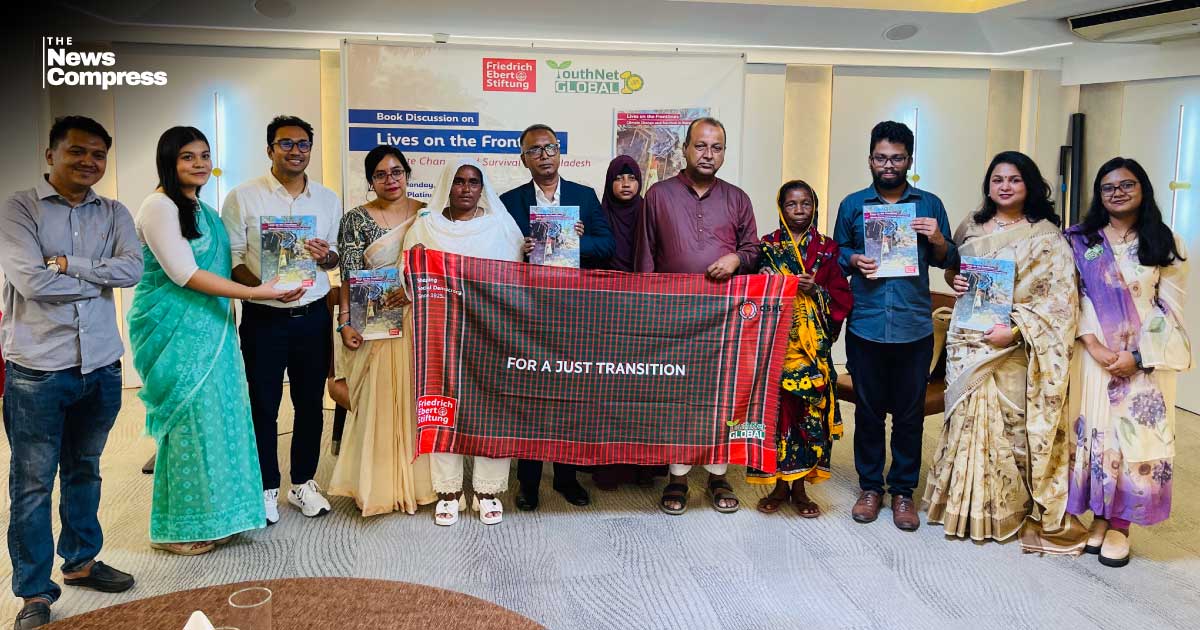
Climate-affected communities, policymakers, researchers and youth leaders have called for stronger participation of frontline populations in climate policy-making, enhanced adaptation support, and greater recognition of lived experiences in national and global climate frameworks.
The call came at a policy dialogue and photo book discussion held in the capital on Monday, jointly organised by YouthNet Global and Friedrich-Ebert-Stiftung (FES) Bangladesh.
The discussion centered on the photo essay publication Lives on the Frontlines: Climate Change and Survival in Bangladesh, which documents the struggles and resilience of climate-affected communities across the country, including coastal, riverine, char and wetland regions.
Speakers said climate change is not merely a matter of statistics but a lived reality for millions in Bangladesh, stressing the need for more human-centered and inclusive policy approaches.
They also identified the upcoming UN Climate Summit COP31 as a critical opportunity to advance climate finance, adaptation, loss and damage mechanisms, and a just transition agenda, urging stronger and more equitable participation of vulnerable countries in global negotiations.
Delivering the keynote remarks, Dr Kazi Shahjahan, Joint Secretary of the Economic Relations Division (ERD), said climate finance is not only about mobilising funds but also ensuring fair and accountable distribution.
“Climate finance is not just about resource mobilisation; it must ensure that the most vulnerable people receive priority. Transparency, accountability and local priorities are crucial,” he said.
Dr Felix Gerdes, Resident Representative of Friedrich-Ebert-Stiftung (FES) Bangladesh, said climate change is not an abstract issue but one that directly affects human lives.
“Climate change is not statistics. It is people’s lived reality, and policies must reflect that,” he added.
YouthNet Global Executive Coordinator Sohanur Rahman stressed that climate justice can only be achieved when affected communities are actively included in decision-making processes.
“Climate justice is possible only when affected people are not just participants but active decision-makers. No policy is complete without their lived experiences,” he said.
He also emphasized the importance of engaging youth and women not only as participants but as leaders in climate action.
International Centre for Climate Change and Development (ICCCAD) Youth and Gender Programme Coordinator Sumaiya Binte Selim said locally led adaptation is essential for building climate resilience.
“Local knowledge and community leadership are essential. Without empowering local people, climate response will not be sustainable,” she said.
A special session featured testimonies from climate-affected communities.
Sonamoni from Shyamnagar, a “tiger widow” from the Sundarbans region, described the hardships faced by coastal families exposed to cyclones and uncertainty.
“We are not only fighting disasters, we are also fighting silence and neglect. No one listens to us,” she said.
Momtaz Begum of the Manta fisherfolk community in Barishal said riverine communities remain excluded from formal decision-making processes.
“Our lives move with the river, but we are not included in policy,” she said.
Shahina Akter from Kurigram’s char areas highlighted the increasing health risks faced by women due to floods and river erosion.
“With every flood, new health risks emerge, but adequate services are not available for us,” she said.
Mudasser Alam, a teacher from Sunamganj’s Tanguar Haor region, said communities in wetland areas seek dignity and security beyond survival.
“We are alive, but mere survival is not enough. We need dignity and security,” he said.
Author of the photobook Harunur Rashid Sagar said visual storytelling plays a crucial role in shaping policy understanding.
“Images can communicate what statistics often cannot,” he said.
Filmmaker Mohammad Rakibul Hasan said visual media can make climate realities more compelling for policymakers.
“Photographs and films move emotions and create pressure for policy change,” he said.
Speakers concluded that climate policies must become more inclusive, accountable and people-centered, warning that climate justice cannot be achieved without integrating frontline experiences.
Organizers said the photo book and dialogue aimed to bridge the gap between local realities and national as well as global climate policy processes, with plans to scale up similar initiatives in the future.