
Published: March 4, 2026, 11:13 PM
A historian’s discovery of handwritten notes in a rare copy of The Almagest suggests that Galileo Galilei deeply studied and critically examined Ptolemy’s geocentric universe long before his famous telescope observations, offering new insight into how he eventually embraced the heliocentric view.
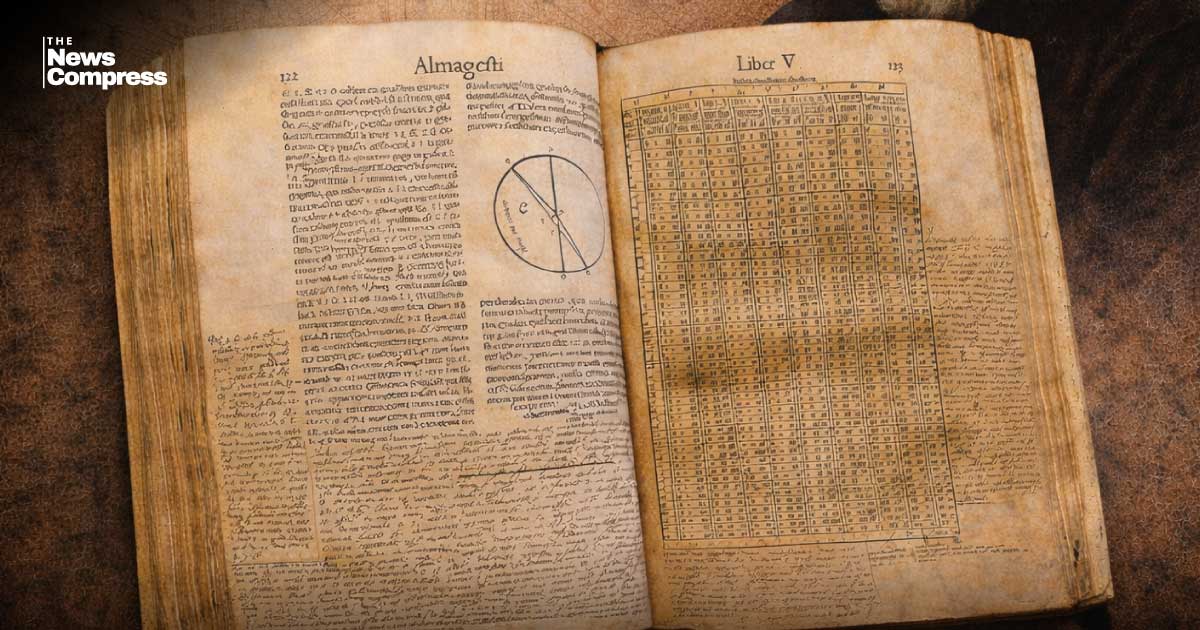
On a cloudy day in January, historian Ivan Malara sat in Italy’s National Central Library of Florence poring over seven 16th century printings of the ancient world’s most influential astronomy text. The pages belonged to The Almagest, in which second century polymath Claudius Ptolemy described his vision of an Earth-centered cosmos. As Malara flipped through the pages, he spotted something out of place. Someone had transcribed Psalm 145 on an otherwise blank page—in handwriting reminiscent of a very, very famous Tuscan astronomer.
That book, Malara came to realize, had been extensively annotated by none other than Galileo Galilei. Malara’s discovery, described in a paper now under review at the Journal for the History of Astronomy, promises new insights into one of the most famous ideological transitions in the history of science: the moment when Earth was thrust from the center of our universe.
It’s rare enough to link an entire new book to the textual record of Galileo. But The Almagest wasn’t just any old book. If Galileo today is often praised for rejecting the authority of ancient wisdom and helping make it obsolete, The Almagest—whose description of a geocentric cosmos reigned over Western astronomy for 14 centuries—was that ancient wisdom incarnate. The annotated version of The Almagest offers a more nuanced portrait: the revolutionary as a young man.Galileo’s notes, perhaps written around 1590, or roughly 2 decades before his groundbreaking telescope observations of the Moon and Jupiter, reveal someone who both revered and critically dissected Ptolemy’s work. And they imply, Malara argues, that Galileo ultimately broke with Ptolemy’s cosmos because his mastery of the traditional paradigm’s reasoning convinced him that a heliocentric system would better fulfill Ptolemy’s own mathematical logic. That interpretation contrasts with many historians’ typical portrayal of Galileo as being motivated by philosophy or even political savvy, not careful math. “He has been presented as a big-picture sort of guy—not interested in the nitty-gritty technical details of astronomy,” says James Evans, a historian of astronomy at the University of Puget Sound.
This didn’t sit right with Malara, a postdoctoral scholar at the University of Milan. Skeptical that Galileo could have come to his bold stances on heliocentrism without a strong grounding in traditional mathematical astronomy, he spent years collecting examples of Galileo quoting technical details from Ptolemy to chastise scholarly rivals and make his own arguments. Hoping to find more direct evidence of the link between Galileo’s and Ptolemy’s conceptions of the cosmos, Malara decided to survey early Latin printings of The Almagest across European libraries, starting with copies in Vienna. Then, in Florence, he ran across the annotated copy.
As Malara looked at the page scrawled with Psalm 145, he was immediately reminded of Galileo’s handwriting. Eyeing more of the book’s dense marginal notes, his suspicion grew. By 3 a.m. the following night, a sleepless Malara was convinced the notes were in the astronomer’s hand. “Forgive the awkward hour,” he wrote from his hotel room, dashing off an email to two of Italy’s leading Galileo scholars, “but I can’t believe my eyes!”
Michele Camerota at the University of Cagliari, one of the scholars Malara first emailed, was quickly convinced. “I regard the attribution of the marginal notes to Galileo as fully secure,” he wrote in an email to Science.
He owes his confidence to several lines of evidence. First, handwriting specialists affiliated with the Galileo Museum and the National Central Library and scholars including Camerota have corroborated Malara’s view that the writing, annotating styles, and abbreviations match Galileo’s. Second, the annotator’s critical comments on several of Ptolemy’s ideas resemble passages from Galileo’s contemporary works. The third line of evidence came from what initially piqued Malara’s interest: the transcribed psalm itself.
At first, the psalm—both a prayer and a poem exalting God’s greatness—had bemused Malara. This was the only early printing of The Almagest he had seen with a biblical reference, and it seemed contrary to both the modern stereotype of Galileo flouting religious authority and Malara’s own experience studying Galileo’s writings. But in another 16th century printing of The Almagest in Florence, he found a note by an unknown author claiming that “Galileo, before studying Ptolemy, offered a prayer to God.” That jibes with a 1673 letter written by the mathematician Alessandro Marchetti, who also said Galileo prayed each time he sat down with The Almagest.
When we think of Galileo today, Malara says, we tend to think of the late-stage version—a scientific celebrity defying both the church and thousands of years of received wisdom. How one of history’s most famous iconoclasts grew into that revolutionary stance, though, is still less clear. Malara hopes his discovery will open new lines of inquiry into that transition. “The big problem, is how? Why?”